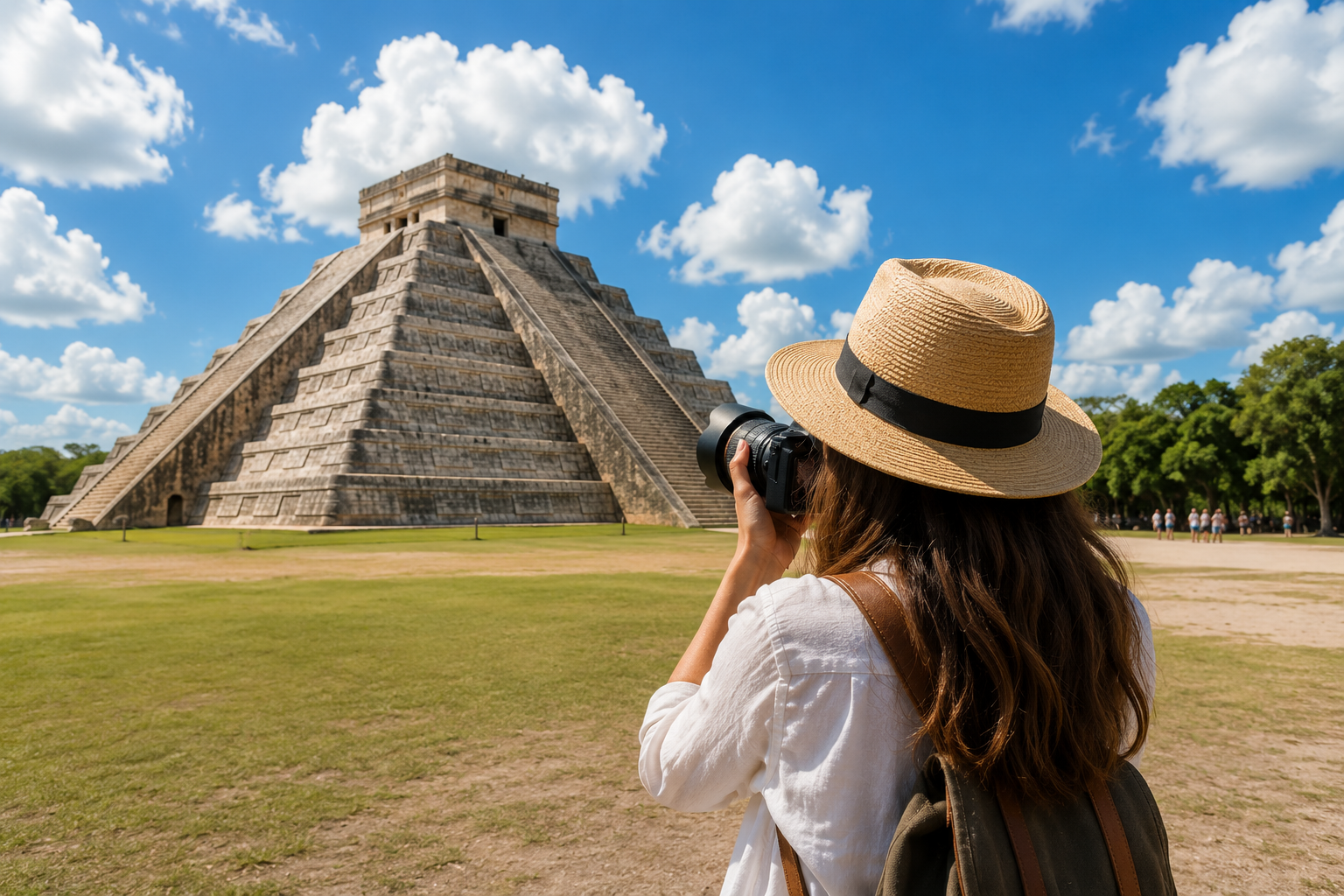
Personal photography with a smartphone or ordinary handheld camera is generally allowed throughout the public visitor areas at Chichén Itzá. Different rules may apply to tripods, drones, professional productions, commercial projects, and larger equipment setups. Follow the current signs and staff instructions, as rules at archaeological sites can change.
Chichén Itzá offers far more photographic variety than El Castillo alone. You can photograph the Great Ball Court, Temple of the Warriors, Group of a Thousand Columns, smaller platforms, carvings, and wide ceremonial spaces. The main practical challenges are usually heat, crowds, strong light, and limited time rather than permission to take ordinary holiday photos.
Tickets & Tours
Choose Your Visit Date
Choose Your Visit Date
Choose Your Visit Date
Are personal photos allowed at Chichén Itzá?
Personal photography is generally permitted during normal opening hours. Visitors regularly use smartphones, compact cameras, mirrorless cameras, and DSLRs to record their day. You can photograph the principal structures and surrounding archaeological areas as long as you remain within public sections and follow local instructions.
Holiday photographs, family pictures, and images shared on personal social media normally fall within personal use. A planned advertising campaign, documentary, commercial shoot, or professional production may be treated differently. Both the purpose of the images and the scale of the equipment can affect how staff assess the activity.
Using a high-quality camera does not automatically turn an ordinary visit into professional photography. Many travellers carry mirrorless or DSLR cameras because photography is their hobby. Questions are more likely when the setup includes tripods, lighting, models, large crews, repeated costume changes, or equipment that obstructs visitor routes.
Always keep equipment away from historic structures. Do not rest cameras or bags against ruins, place accessories on carvings, or block narrow paths while arranging a photograph. These restrictions protect the archaeological remains and keep the public areas accessible to other visitors.
Can you use a professional camera?
A professional-looking camera may attract more attention than a phone, but the camera body is not necessarily the deciding factor. Staff may consider the complete setup, how you use it, and what the final images are intended for. A single handheld camera used during a normal visit is easier to manage than an organised production with multiple accessories.
Check the current policy before travelling with expensive or specialised equipment, particularly when the images have a commercial purpose. Professional photography may require prior permission from the relevant heritage authority. Arranging approval before the visit is safer than assuming it can be organised at the entrance.
For personal photography, keep the setup as light as possible. One camera and a versatile lens are easier to carry through the heat and allow you to move freely between monuments. A flexible zoom covers wide architectural views and smaller details without frequent lens changes in dusty outdoor conditions. A lightweight prime lens also works well if image quality matters more than range.
The best equipment is the setup you can comfortably carry for several hours. Heavy bags and repeated lens changes slow down the route and become tiring around midday. Bring the equipment you expect to use rather than every lens that might be useful.
Are tripods allowed at Chichén Itzá?
Do not assume that you will be allowed to use a tripod at Chichén Itzá. Tripods take up space, obstruct visitor routes, and can make a personal visit resemble a professional production. Even a compact model may attract attention in crowded areas around El Castillo or the Great Ball Court.
The same caution applies to monopods, large stabilisers, lighting stands, and similar supports. Local staff decide what is acceptable under the conditions on the day. Controls may be stricter when viewing areas and paths are busy, so ask before unfolding any support equipment.
A tripod is not essential for most daytime photographs. The open plazas provide enough natural light for fast shutter speeds, while modern phones and cameras offer effective stabilisation. Hold the camera close to your body, keep a steady stance, and use burst mode when you want a better chance of one sharp frame.
Never use walls, carvings, platforms, or other archaeological structures as physical supports. Protected surfaces should remain untouched even if placing a camera there seems harmless. Work with handheld techniques instead of risking damage or attracting unwanted attention.
Can you use a drone at Chichén Itzá?
Regular visitors should not expect to fly a drone freely over Chichén Itzá. Archaeological sites are protected spaces, and aerial recording is subject to much stricter control than ordinary handheld photography. Drones can disturb visitors, create safety risks, and interfere with conservation or security.
Commercial aerial filming requires formal preparation and approval, with aviation rules potentially applying alongside archaeological restrictions. Arriving with a drone does not mean you will receive permission to use it. Anyone planning an aerial project should arrange the necessary authorisation well in advance.
Ground-level photography already provides many strong compositions. El Castillo can be photographed from several sides, and the central plaza offers enough distance for wide views. The Great Ball Court, columns, platforms, and carvings add different lines, scales, and textures without requiring aerial equipment.
Tickets & Tours
Choose Your Visit Date
Choose Your Visit Date
Choose Your Visit Date
What is the best time for photography?
Early morning normally offers the best balance for photography. The light is softer, temperatures are lower, and the largest groups may not yet have arrived. You have more freedom to change position, compare viewpoints, and wait briefly for a clearer composition.
Morning light creates longer shadows around El Castillo and nearby platforms. These shadows add depth and make the form of the structures more visible. As the sun rises, each side of the pyramid changes, so walking around the plaza reveals several lighting conditions within a relatively short period.
Midday is more difficult. Strong overhead light creates bright stone surfaces and deep shadows in the same frame, while reflected light from the open ground can flatten a scene. Careful exposure helps protect detail, but the conditions remain less forgiving and the heat makes patient photography harder.
Late afternoon can bring warmer colours and softer light, but closing time reduces your flexibility. Some structures may fall into shadow before you reach them, leaving less time to repeat a composition. Choosing the best time of day to visit Chichén Itzá affects the light, visitor numbers, temperature, and total time available.
Where are the best photo locations?
El Castillo is the most obvious subject, but it changes as you move around the central plaza. A straight view emphasises its symmetry, while an angled composition gives more depth to the staircases and stepped sides. Including open ground or a few visitors shows the pyramid’s scale, while a tighter frame draws attention to the upper temple and architectural lines.
The Great Ball Court creates a very different photograph. Its long walls lead the eye through the frame, and the stone rings form clear focal points. Wide compositions show the size of the space, while closer images reveal carvings, weathered surfaces, and details that disappear in an overview.
The Temple of the Warriors and the Group of a Thousand Columns work well for repeated patterns. Side lighting adds texture and helps separate the individual columns. These areas are useful when you want images that look different from the familiar view of El Castillo.
Smaller platforms, stairways, and carvings also deserve time. They may not have the immediate impact of the pyramid, but they add variety and create a stronger visual record of the site. This range of monuments is one reason many travellers feel that Chichén Itzá is worth visiting even when the central plaza is busy. Moving beyond the most famous viewpoint often produces the most original photographs.
How can you photograph El Castillo without large crowds?
A completely empty photograph is difficult because El Castillo is the busiest part of the site. Arriving early gives you the best chance of fewer people in the central plaza, although you may still need to wait for visitors to move. Patience and positioning are more useful here than complicated equipment.
Change your angle instead of waiting indefinitely in one crowded location. Moving a few metres can remove people from the foreground or place them against a less distracting part of the background. Lower viewpoints and tighter framing can also reduce the visible crowd, while one or two people sometimes improve the image by showing scale.
Take several frames from the same position when groups are walking through the scene. People move quickly between photographs, and a short burst may capture a much clearer moment. This technique works less well when a tour group has stopped for a long explanation, so try another part of the plaza and return later.
Do not block a popular viewpoint while waiting for a perfectly empty photograph. Take your images, move aside, and give other visitors access to the same position. You can revisit the viewpoint if the situation changes later in your route.
How much time should photographers allow?
Most visitors spend about two to three hours inside Chichén Itzá. Photography can extend that time because changing light, viewpoints, and crowds encourage repeated stops. Someone taking occasional phone pictures may remain within the normal timeframe, while a keen photographer may prefer three to four hours.
El Castillo alone can occupy more time than expected if you walk around it, compare several sides, and wait for clear views. The Great Ball Court, Temple of the Warriors, columns, carvings, and secondary platforms then add further possibilities. A tightly scheduled visit makes it difficult to explore these differences.
Heat also affects your pace. Carrying a camera and standing in open areas becomes tiring around midday, so include water and short breaks in the schedule. A slower route often produces better images because you notice details that are easy to miss when moving quickly.
Understanding how long a visit to Chichén Itzá takes helps you reserve enough time without overloading the rest of the day. Photographers should normally work with the longer end of the suggested range, especially if they want to explore beyond El Castillo.
Tickets & Tours
Choose Your Visit Date
Choose Your Visit Date
Choose Your Visit Date
What camera settings work well?
Bright outdoor conditions normally allow a low ISO and a reasonably fast shutter speed. This reduces visible noise and the risk of camera movement while preserving architectural detail. A medium aperture keeps much of a monument or plaza sharp, although the exact settings depend on the camera, lens, and available light.
Watch the highlights on pale stone surfaces. A camera may expose for darker ground or sky and make the pyramid appear too bright. Slightly reducing the exposure can retain more detail in the stone. Check the histogram when possible rather than relying only on the rear screen in strong sunlight.
Wide-angle lenses suit plazas, the Great Ball Court, and full views of El Castillo. Extremely wide lenses may distort straight lines near the edges, so step back when possible and keep the camera level. This creates a more natural architectural perspective.
A longer lens is useful for carvings and upper sections that visitors cannot approach closely. It can also isolate a detail from a crowded background. You do not need a very large telephoto lens for most scenes; a moderate zoom provides enough flexibility without adding excessive weight.
Can you photograph people at Chichén Itzá?
Family and travel portraits are a normal part of visiting Chichén Itzá. The open plaza around El Castillo provides several backgrounds, and morning light is usually more flattering than harsh midday sun. Positioning a person with the sunlight slightly to one side reduces strong shadows across the face.
Be considerate when photographing strangers. Other visitors will appear incidentally in wide views, but a close portrait is different. Ask permission when one person is clearly the subject, particularly when photographing local workers, performers, or vendors.
Never direct someone into a restricted area for a photograph. Barriers and signs protect visitors and archaeological remains. Climbing, sitting on ruins, or crossing closed sections is not justified by a better composition.
Professional portrait sessions may be treated differently from ordinary family pictures. Models, repeated costume changes, reflectors, specialised equipment, or a larger team can make a shoot appear commercial. Arrange permission in advance when the activity goes beyond a normal visitor experience.
Are selfie sticks allowed?
A compact selfie stick may be tolerated in some outdoor areas, but use it carefully. Extended sticks can become inconvenient or unsafe at busy viewpoints, and staff may restrict them when they obstruct paths or approach protected structures. Follow the instructions given at the site.
Keep the stick close to you and do not sweep it through crowded spaces. Never extend it over barriers or towards carvings. The additional reach does not provide permission to enter or photograph from restricted areas.
Asking another visitor to take a picture often creates a more natural result than a very wide selfie. It also makes framing El Castillo in the background easier. Offering to return the favour is a simple way to get a useful photograph without carrying extra equipment.
How should you protect your equipment?
Chichén Itzá can be hot, humid, dusty, and occasionally wet. A lightweight camera bag protects your equipment without adding too much weight. Keep it closed when you are not changing lenses because dust enters quickly in open visitor areas.
Rain showers can develop during wetter months. A simple camera cover or sealed bag protects equipment when conditions change unexpectedly, while a cloth helps remove moisture from the camera body. Do not rely entirely on the weather forecast.
Heat affects batteries and electronics. Avoid leaving camera equipment inside a closed vehicle for several hours, keep spare batteries out of direct sunlight, and watch for a phone overheating during continuous video recording. Parking at Chichén Itzá requires some preparation when deciding which belongings to take towards the entrance.
Carry only the equipment you expect to use. A lighter bag reduces fatigue and makes it easier to move through crowded areas. One practical camera setup is often better than several lenses that remain unused.
Tickets & Tours
Choose Your Visit Date
Choose Your Visit Date
Choose Your Visit Date
Can you film video at Chichén Itzá?
Short personal videos recorded with a phone or ordinary handheld camera are generally treated like personal photography. Local restrictions or fees may still apply, while larger video setups can fall under professional or special-equipment rules. The purpose and scale of the recording matter.
Keep personal filming brief at crowded viewpoints. Recording a long sequence from one position can block other visitors, so move aside when reviewing clips or changing settings. Important viewing areas should remain accessible.
A professional production requires advance preparation. Specialised equipment, a crew, actors, models, or commercial distribution moves the activity beyond an ordinary visit. Formal authorisation may be required, and you should not rely on arranging it after arrival.
Common photography mistakes to avoid
The most common mistakes come from poor timing, carrying too much, or concentrating on only one subject:
- Staying only around El Castillo: The Great Ball Court, columns, carvings, and smaller platforms add essential variety to your photographs.
- Arriving in the strongest midday light: Overhead sunlight creates harsh contrast, while heat reduces patience and concentration.
- Carrying too much equipment: Heavy bags and unused lenses become tiring. Choose a setup that matches your actual plans.
- Ignoring the wider site: Moving slowly through secondary areas often produces more original images than repeating the same pyramid view.
- Assuming every device is permitted: Tripods, drones, professional setups, and commercial projects may face additional restrictions.
- Blocking popular viewpoints: Take your photographs and move aside so other visitors can use the same position.
- Touching archaeological structures: Never place cameras, bags, or supports on ruins, walls, platforms, or carvings.
A lighter setup, an early arrival, and a route beyond the central plaza prevent most of these problems. Respecting local restrictions protects both the archaeological site and the quality of your visit.
Final thought: can you take photos at Chichén Itzá?
Personal photographs are generally allowed in the public areas of Chichén Itzá. Most visitors can use a smartphone or handheld camera for architecture, travel portraits, carvings, and wider compositions. El Castillo is the main subject, but the Great Ball Court, columns, platforms, and smaller structures create a much more varied photographic record.
Professional equipment, tripods, drones, commercial photography, and larger productions may require permission or face restrictions. Check the current policy when your plans go beyond normal handheld photography and follow staff instructions on the day. Early morning offers the most reliable combination of softer light, lower temperatures, and fewer visitors.
To combine your photography plans with tickets, transport, and the rest of the day, use our Chichén Itzá Visitor Guide. The frequently asked questions about Chichén Itzá provide quick answers when you need to confirm one practical detail before packing your camera.